For additional information visit the WA DOH Smoke From Fires Webpage (Información en Español).
Health Impacts
Exposure to wildfire smoke can cause health problems that range from minor to severe. Some symptoms include:
- Eye, nose, and throat irritation (burning eyes and runny nose)
- Fatigue
- Headache and coughing
- Wheezing and shortness of breath
- Aggravation of existing conditions, particularly heart and lung diseases
- Watch for symptoms like asthma attacks, chest pain, or irregular heartbeat
- Mental health concerns and psychological stress
Inhaling smoke is not good for anyone. Everyone should take steps to reduce exposure and monitor symptoms during and following smoke events. Many people are at increased risk of severe health impacts. This includes:
- People with health conditions:
- Lung diseases, such as asthma, chronic obstructive pulmonary disease (COPD), chronic bronchitis, and emphysema.
- Heart or circulatory diseases, such as congestive heart failure or coronary artery disease, and people with a history of heart attack or stroke.
- Respiratory infections, including COVID-19, pneumonia, colds, influenza
- Diabetes
- People 18 and younger or older than 65
- Pregnant people
- Outdoor workers
- People with access or functional needs
- Communities of color
- Tribal members and Indigenous people
- People with low income
- People who are unhoused or unsheltered
How to protect your and your family's health from wildfire smoke
- Stay updated on current and forecasted air quality:
- Check wildfire and smoke locations on the other tabs of this blog. See information on the Air Quality Index, below.
- Limit duration and intensity of outdoor physical activity.
- Stay indoors with cleaner indoor air:
- Close windows and doors unless it is too hot to maintain safe temperatures.
- Filter indoor air through an HVAC system, and a HEPA portable air cleaner, or DIY box fan filter. See below.
- Buy necessary materials early. Supplies will sell quickly once smoke hits.
- Don’t add to indoor pollution.
- Avoid smoking or vaping, burning candles or incense, spraying aerosols, diffusing essential oils, broiling or frying foods, sweeping, and vacuuming (unless your vacuum has a HEPA filter).
- Set HVAC systems to re-circulate mode or close the outdoor/fresh air intake.
- If you must be outside for a limited duration, consider wearing a properly fitted NIOSH-approved particulate respirator, such as an N95 mask. See below.
- If unable to maintain cleaner air at home, go elsewhere for cleaner air such as a friend’s place, public space, or unimpacted area.
- It can be a challenge to keep smoke out when it’s hot, especially without an air conditioner or central cooling system. Pay attention to rising temperatures, as heat-related illness can occur quickly and can be life threatening.
- Close windows and curtains or shades during the day and use portable fans.
- Stay hydrated, especially with water. Avoid sugary or alcoholic drinks since these can be dehydrating.
- Minimize use of your stove and oven during the hottest part of the day.
- Cool off by taking a cool shower or bath. Be mindful of extreme temperature changes, which can cause life-threatening issues.
- Use ice packs or put your feet in cool water. Apply wet rags on the back of your neck or mist yourself with water while sitting near a fan.
- Track air quality and open windows when the air quality improves.
- Open windows when it is cooler outside than inside, and, if possible, take steps to filter indoor air. See below.
- Go to an indoor place that is cooler - even if only for a few hours. For updated information on cooling centers in your community, visit Washington 2-1-1.
- For information about preventing heat-related illness, follow DOH's Hot Weather Safety Guidance or CDC's Preventing Heat-Related Illness.
- For more information, see Cooling Indoor Spaces Without Air Conditioning (PDF).
- To check your area's current and forecasted heat risk and find suggested precautions, see CDC's Heat Risk.
Air Quality Index
The Air Quality Index (AQI) reports the level of air quality and health concerns across six color-coded categories. The AQI map is shown at the top of this page. The breakpoints for AQI categories are listed on ORCAA's website. The table below lists what you should do at each AQI category.
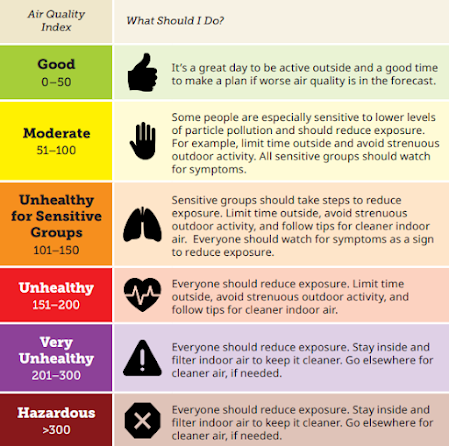
For more information, see Washington Air Quality Guide for Particle Pollution.
Filtering indoor air in your home
For your home, consider one of three options:
1. If you have a heating, ventilation, and/or air conditioning (HVAC) system, set it to recirculate and close the fresh air intake while there is bad air quality. Increase the filtration to a MERV 13 rated filter, or the highest rated filter your system will handle. Select a filter with the deepest folds in the filter material your system can accommodate. Consult your HVAC manual or speak with an HVAC professional before making improvements. Change the filter when dirty or when indicated in your HVAC manual.
2. Use a HEPA portable air cleaner. Choose a portable air cleaner that is:
- Filter only - no ionic, ozone, or UV technologies.
- A real HEPA filter.
- The right size for your room.
- Not too loud.
See DOH guidance on selecting portable air cleaners for additional information.
3. Make your own box fan filter using a standard box fan (2012 or newer) and one or more filter(s) of the same dimensions with a MERV 13 rating. Testing by UL and EPA found no safety concerns with box fans 2012 or newer, but box fans are not designed to operate with a filter attached.
- Follow box fan manufacturer's instructions.
- Keep away from a window or wall so that the front and back are not blocked. Do not operate in a window.
- See this post for more info or watch these videos:
Using a mask for wildfire smoke
Using a mask for wildfire smoke
- If you must go outside during a wildfire smoke event, certain types of masks can provide some protection. N95 or other NIOSH-approved respirators filter out most fine particles in smoke but not hazardous gases, such as carbon monoxide. It's important to take necessary steps to wear them correctly to achieve a proper fit and seal to provide protection.
- For more information:
Protecting children and students from wildfire smoke
- Children and youth are more sensitive to health effects from breathing in smoke because they breathe in more air than adults for their body weight and their respiratory systems are still developing.
- Children’s Health & Wildfires - Western States Pediatric Environmental Health Specialty Units (PEHSU).
- The Washington Children and Youth Activities Guide (PDF), provides recommendations to protect children and youth from PM2.5 (the main component in wildfire smoke). It can be applied to school, childcare, athletic practices and games, before and after school programs, camps, field trips, and other outdoor programming and activities.
- Children’s Health & Wildfires - Western States Pediatric Environmental Health Specialty Units (PEHSU).
